
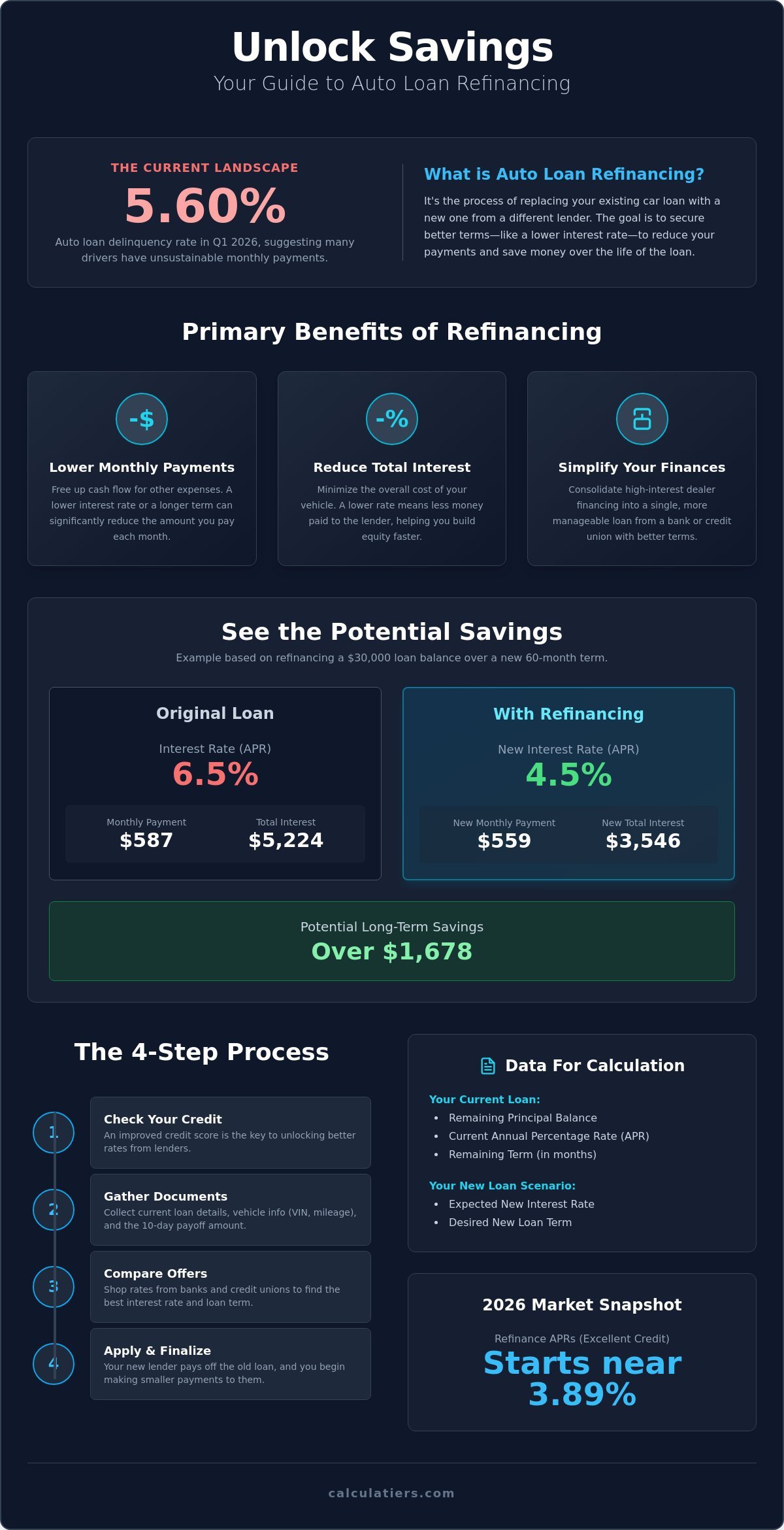
Auto loan delinquencies reached 5.60% in the first quarter of 2026, which is well above the long-term average. This trend suggests that many drivers are locked into monthly payments that have become unsustainable. You probably feel that your original dealer financing is costing you too much, especially when competitive refinance rates for excellent credit currently start near 3.89%. Our auto loan refinance calculator provides a fast, transparent way to see how much you can save by securing a lower interest rate or a more favorable loan term.
We understand that navigating loan terms can be confusing, but the math should be clear. This article promises to show you how to reduce your monthly payment and minimize the total interest paid over the life of your loan. We will preview the specific lender requirements for vehicle age and mileage, explain how to find your break-even point, and help you decide if refinancing makes sense for your budget. You can expect a direct, data-focused look at your options without the need for personal sign-ups or complex commitments.
Key Takeaways
- Understand how replacing your existing car loan with a new agreement can secure a lower interest rate and reduce your total debt obligation.
- Utilize our auto loan refinance calculator to generate instant, accurate savings estimates using standard amortization formulas without requiring a sign-up.
- Learn to calculate your break-even point to ensure that the reduction in interest outweighs any processing or administrative fees.
- Navigate the 2026 lending landscape by identifying how your credit score and vehicle age impact the rates offered by modern lenders.
- Follow a clear, step-by-step guide to verifying your financial data and preparing your credit report for the refinancing process.
Understanding Auto Loan Refinancing and Its Primary Benefits
Auto loan refinancing is the process of paying off an existing vehicle loan with a new loan from a different lender. This financial move is designed to optimize your debt structure by securing better terms than those offered by your original dealer or bank. Understanding Auto Loan Refinancing helps you recognize that the new loan effectively replaces the old one, often with a lower interest rate or a revised repayment schedule. Unlike mortgage refinancing, which involves complex appraisals and lengthy closing periods, auto refinancing is typically faster and requires less documentation. It’s a high-efficiency tool for managing personal debt.
Drivers generally pursue this option to achieve three specific outcomes:
- Improved Monthly Cash Flow: Reducing the amount due each month to free up capital for other expenses.
- Reduced Total Interest: Minimizing the cost of borrowing over the entire life of the loan.
- Debt Consolidation: Simplifying finances by moving high-interest dealer debt to a more favorable bank or credit union loan.
Using an auto loan refinance calculator allows you to model these outcomes instantly. It provides a clear comparison between your current obligation and potential new offers, removing the guesswork from the decision-making process. You can see the impact of different interest rates and terms before you ever contact a lender.
Lowering Your Monthly Car Payment
Immediate budget relief is a primary driver for many applicants. You can lower your monthly payment in two ways. First, securing a lower Annual Percentage Rate (APR) reduces the interest portion of each installment. Second, you can extend the loan term. While extending the term may increase total interest costs, it provides essential breathing room for those facing tight monthly constraints. A reliable auto loan refinance calculator will show you exactly how these changes impact your monthly budget.
Reducing Total Interest Paid Over the Loan Life
Long-term savings often provide the greatest financial advantage. If your credit score has improved, you can qualify for a lower rate. For example, on a $30,000 car loan, dropping your rate by just 2% can save you over $1,500 in total interest over a 60-month term. Shortening the loan term while lowering the rate reduces the time you’re in debt and cuts the total cost of the vehicle. This strategy builds equity faster and keeps more money in your savings account over time.
Calculating Your Potential Savings: Understanding the Inputs
Accuracy in financial planning requires precise data. An auto loan refinance calculator operates on standard amortization formulas to project your future payments. These calculations determine how much of each payment goes toward interest versus principal. Gather your documents. To get the most reliable results, you should understand how each variable impacts the final output. You can find excellent consumer tools for auto loans through government resources to help you interpret these complex variables.
Obtain your 10-day payoff amount from your current lender before you begin. This figure differs from the “remaining balance” shown on your mobile app. It includes the daily interest that accumulates between your last payment and the date the loan is closed. Using the exact payoff amount ensures your new loan covers the old debt entirely. For an immediate estimate without the friction of account registration, input these numbers into the Calculatiers tool.
Current Loan Details: The Baseline
Your current loan serves as the control group for your savings experiment. You need three specific figures. First, enter your remaining principal balance. Second, locate your current Annual Percentage Rate (APR). Finally, determine your remaining term in months. If you started with a 72-month loan and have made 24 payments, your remaining term is 48 months. This baseline allows the calculator to establish exactly how much interest you’ll pay if you make no changes.
New Loan Details: The Refinance Scenario
The second half of the calculation involves your potential new terms. Input the new interest rate you expect to receive. As of July 2026, borrowers with excellent credit have seen refinance APRs as low as 3.89%. Next, choose your new loan term. This choice creates a significant mathematical trade-off that impacts your long-term wealth.
Lengthening your term, such as moving from 48 months to 60 months, spreads the principal over more payments. This action reduces your monthly obligation but increases the total interest paid over the life of the loan. Conversely, shortening the term increases the monthly cost but slashes the total interest expense. Our auto loan refinance calculator makes this relationship visible instantly, helping you decide which priority fits your current financial strategy.
Strategic Timing: When to Use an Auto Refinance Calculator
Timing a refinance requires more than just watching the calendar. It involves a precise intersection of your personal credit health and broader economic conditions. In July 2026, market data shows that refinance APRs for consumers with excellent credit have reached lows of 3.89% for new vehicles. However, lenders are tightening underwriting standards due to a 5.60% delinquency rate in the auto sector. Before applying, you must identify your break-even point. This is the moment where your total interest savings exceed the cost of any refinancing fees. For instance, if a lender charges a $395 processing fee, your auto loan refinance calculator results should show at least that much in interest reduction to make the transition profitable.
Analyze your vehicle’s equity before proceeding. Owing more than the car is worth, known as negative equity, is a significant barrier. Most lenders impose strict loan-to-value (LTV) limits, often requiring the vehicle to be worth at least 100% of the loan amount. Additionally, review your original contract for prepayment penalties. While these fees are less common in modern lending, they can negate the benefits of a lower rate. Understanding your auto loan terms is essential for avoiding these hidden costs. If your current loan is nearly paid off, the savings might not justify the administrative effort.
Your Credit Score Has Improved
A higher credit score is the most powerful lever for reducing your APR. If your score has moved up a tier since you first financed your car, you likely qualify for better terms. Lenders generally offer their most competitive rates to borrowers with scores above 720. Moving from a “Fair” score to a “Good” or “Excellent” rating can drop your interest rate by several percentage points. This shift can save you thousands of dollars over the remaining life of the loan. Use the auto loan refinance calculator to model how a 2% or 3% rate reduction impacts your total debt obligation.
Market Interest Rates Have Declined
External economic factors influence the benchmarks lenders use for auto loans. If the Federal Reserve has lowered interest rates since you signed your original agreement, refinancing becomes a viable strategy even if your credit score remains the same. Even a 1% drop in market rates justifies a new calculation. Frequent “rate checks” help you spot these windows of opportunity. Since 2026 rates are currently volatile, monitoring the market allows you to lock in a lower rate before conditions shift again. This proactive approach ensures you never pay more for your vehicle than the current market requires.
The Step-by-Step Refinancing Process
Refinancing requires a methodical approach. Capture the best available market rates by following a structured plan. Begin by using the auto loan refinance calculator to establish your target monthly payment. This initial step prevents you from accepting an offer that doesn’t align with your budget goals. Once you have a clear savings target, review your credit report. Inaccuracies in your history can lead to higher APRs. Disputing errors before you apply ensures lenders see your true creditworthiness. This preparation is essential in 2026 as lenders tighten their underwriting standards.
Gather your financial and vehicle data to streamline the application phase. Most lenders require proof of steady income and current insurance coverage. You must also provide your vehicle’s registration and current mileage. A critical document is the 10-day payoff letter from your existing bank. This letter specifies the exact amount needed to close your current account, including the per diem interest. Having these items ready allows you to move through the approval process without administrative delays. To verify your math before submitting documents, use the auto loan refinance calculator for a final check.
Documentation You Will Need
Lenders require specific details to value your vehicle and assess risk. You must provide the Vehicle Identification Number (VIN) and current mileage. These figures determine if the car meets age and wear requirements. For example, some lenders only refinance vehicles 10 years old or newer with less than 120,000 miles. Providing proof of insurance and your 10-day payoff amount ensures the new lender can successfully transfer the title. Preparation reduces friction and speeds up your time to approval.
Comparing Lenders Efficiently
Compare offers from a mix of institutions. Include your local credit union, traditional banks, and specialized online lenders. Each has different risk tolerances and may offer varying rates based on the July 2026 market benchmarks. Complete all applications within a 14-day window. Credit scoring models typically treat multiple inquiries for the same loan type as a single event if they occur within this timeframe. This strategy protects your credit score while you hunt for the lowest cost of capital.
Look beyond the advertised APR. Some lenders may offer no origination fees, while others might charge several hundred dollars for processing. Use your calculation results to determine if a lower rate justifies a high upfront fee. Once you select a lender, finalize the paperwork and confirm that your old loan balance is paid in full. Do not stop making payments on your original loan until you receive written confirmation that the account is closed and the balance is zero.
Efficient Financial Planning with Calculatiers Tools
Financial decisions require immediate data, not marketing delays. Our auto loan refinance calculator delivers results without the friction of account creation or personal data collection. We prioritize speed and clarity to ensure you can model different debt scenarios in seconds. This functional approach allows you to focus on the mathematics of your loan rather than navigating sales funnels. By providing a transparent utility, we empower you to take control of your monthly obligations with quiet confidence.
A successful refinance is often just one part of a larger financial strategy. We encourage you to look at your total debt landscape to find additional optimization opportunities. Using a variety of specialized tools helps you understand the long-term impact of every dollar you spend on interest. Our commitment to free, accessible financial education ensures that high-quality data remains available to everyone, regardless of their credit score or income level.
No Sign-Up, Instant Results
Privacy is a core component of our user experience. We don’t ask for your email address, phone number, or social security details to run a calculation. Many competitors use their tools as lead magnets to generate sales calls for specific lenders. We reject this model. Our tool is entirely browser-based, meaning your financial inputs stay private. You get the answers you need immediately, allowing you to compare market rates from July 2026 against your current terms without fear of unwanted marketing follow-ups.
Building a Comprehensive Debt Strategy
Integrate multiple data points to create a sustainable monthly budget. Once you determine your potential savings with the auto loan refinance calculator, use our Amortization Calculator to see how your principal balance will decrease over time. This helps you visualize the speed at which you build equity in your vehicle. If you are considering other types of borrowing, our Loan Calculator provides a broader view of how different interest rates affect your overall cash flow.
Regular financial check-ups lead to better long-term outcomes. Market conditions change, and your credit score may improve as you pay down debt. Use these tools frequently to spot new opportunities for interest reduction. By removing the traditional barriers to financial information, we provide a reliable guide for your debt management journey. Knowledge of the math behind your loans is your best defense against predatory lending practices and unnecessary interest expenses.
Take Control of Your Auto Debt
Reducing your car payment is a matter of mathematics and timing. You now understand how a lower interest rate or a strategic adjustment to your loan term can provide immediate budget relief. By identifying your break-even point and gathering the necessary documentation, you can navigate the 2026 lending market with precision. Our auto loan refinance calculator serves as your starting point; it provides the data you need to negotiate with confidence. We have covered the inputs required for accuracy, the importance of the 10-day payoff amount, and how to protect your credit score during the application process.
Calculate your auto loan refinance savings instantly on Calculatiers. You will receive instant results directly in your browser without providing any personal information or signing up for an account. Our mission is to provide free financial tools for everyone to ensure transparency in the lending process. Use these insights to make an informed decision that strengthens your long-term financial health. Start optimizing your debt today.
Frequently Asked Questions
How much does it cost to refinance an auto loan?
Refinancing costs vary significantly depending on the lender and your state of residence. Some institutions, such as Navy Federal Credit Union, advertise no origination or application fees. Other platforms may charge processing fees ranging from $395 to $499. You must also account for state title transfer and registration fees, which are typically under $100. Always request a full fee schedule before signing to ensure the costs don’t outweigh your interest savings.
Will refinancing my car loan hurt my credit score?
Refinancing results in a temporary decrease in your credit score due to a hard credit inquiry. However, this impact is usually minor and short-lived. If you submit multiple applications within a 14-day window, credit bureaus generally treat them as a single inquiry to protect your rating. Your score typically recovers as you establish a consistent payment history with the new lender. Avoid opening other new lines of credit during this period.
Can I refinance a car loan if I owe more than the car is worth?
Refinancing is difficult if you have negative equity, but it isn’t impossible. Most traditional lenders require a loan-to-value (LTV) ratio of 100% or less, meaning the loan cannot exceed the car’s current market value. If you are “upside down,” you may need to pay the difference upfront to qualify. Some specialized lenders allow LTVs up to 125%, though these loans often carry higher interest rates that may limit your savings.
How soon can I refinance a new car loan after purchase?
You can technically refinance as soon as the vehicle title is officially registered in your name. Most lenders require a waiting period of 60 to 90 days to ensure the original lien is properly recorded and your initial payments are processed. This timeframe also allows your credit score to stabilize after the hard inquiry from your initial purchase. Check with your new lender for their specific seasoning requirements before applying.
What is the minimum credit score needed to refinance an auto loan?
Lenders generally require a minimum credit score of 600 for a standard refinance. Borrowers with scores above 720 qualify for the most competitive rates, which reached as low as 3.89% in July 2026. If your score is in the “Fair” or “Poor” range, you may still find offers through subprime specialists. However, these rates can be as high as 19% or more, making it essential to verify the math using an auto loan refinance calculator.
Is there a limit to how many times I can refinance my car?
There is no legal limit on the number of times you can refinance a vehicle. Each new loan must meet the lender’s criteria regarding the car’s age, mileage, and remaining balance. Most banks won’t refinance vehicles older than 10 years or those with over 120,000 miles. Frequent refinancing can also lead to an “upside down” loan if you repeatedly roll fees into the principal balance or extend the repayment term excessively.
Does a lower monthly payment always mean I am saving money?
A lower monthly payment does not guarantee long-term savings. If you reduce your payment by extending the loan term, you may end up paying significantly more in total interest over the life of the loan. True savings occur when you secure a lower interest rate without extending the timeline. Use an auto loan refinance calculator to compare the “Total Interest Paid” on your current loan against any new offer to identify the most cost-effective path.
What is a prepayment penalty and does it affect my refinance?
A prepayment penalty is a fee some lenders charge if you pay off your loan before the end of the term. While these are increasingly rare in modern auto contracts, you must review your original loan agreement for this clause. If a penalty exists, it is usually a percentage of the remaining balance or a set number of months’ interest. You must include this cost in your break-even calculation to determine if refinancing remains a profitable move.