
Did you know that a single percentage point difference in your mortgage and interest rate could cost you over $100,000 in interest over the life of a standard loan? It’s a staggering figure that illustrates why precise math matters more than general market trends. You’re likely feeling the pressure of 2026 market volatility and the confusing overlap between interest rates and APR. It’s difficult to see the true cost of borrowing when the numbers seem to shift every week.
We’re here to clear that confusion. This guide shows you exactly how mortgage interest is calculated and how it impacts your total home cost over time. You’ll learn to compare the financial outcomes of 15-year and 30-year terms with confidence. We’ll break down current 2026 benchmarks, such as the 6.61% average for 30-year fixed loans and the 5.99% rate for 15-year options. This walkthrough provides the logic you need to choose a rate structure that fits your long-term financial goals without the guesswork.
Key Takeaways
- Understand how amortization works to see how interest is calculated on your remaining principal balance every month.
- Learn how a 1% shift in your mortgage and interest rate can change your total home buying power by approximately 10%.
- Compare the long-term interest savings of a 15-year term against the lower monthly payment flexibility of a 30-year mortgage.
- Identify how specific variables like credit scores and down payment sizes directly influence the interest rates lenders offer you.
- Discover how to calculate the full cost of borrowing, including taxes and insurance, to build an accurate 2026 housing budget.
Understanding Mortgage Interest Rates and How They Work
A mortgage interest rate is the fee a lender charges for the use of their capital. When you ask, What is a mortgage?, you’re essentially describing a secured loan where the property serves as collateral. The interest rate represents the “sticker price” of that loan, calculated as a percentage of the remaining principal balance. Every month, a portion of your payment covers this interest, while the rest reduces the principal you owe.
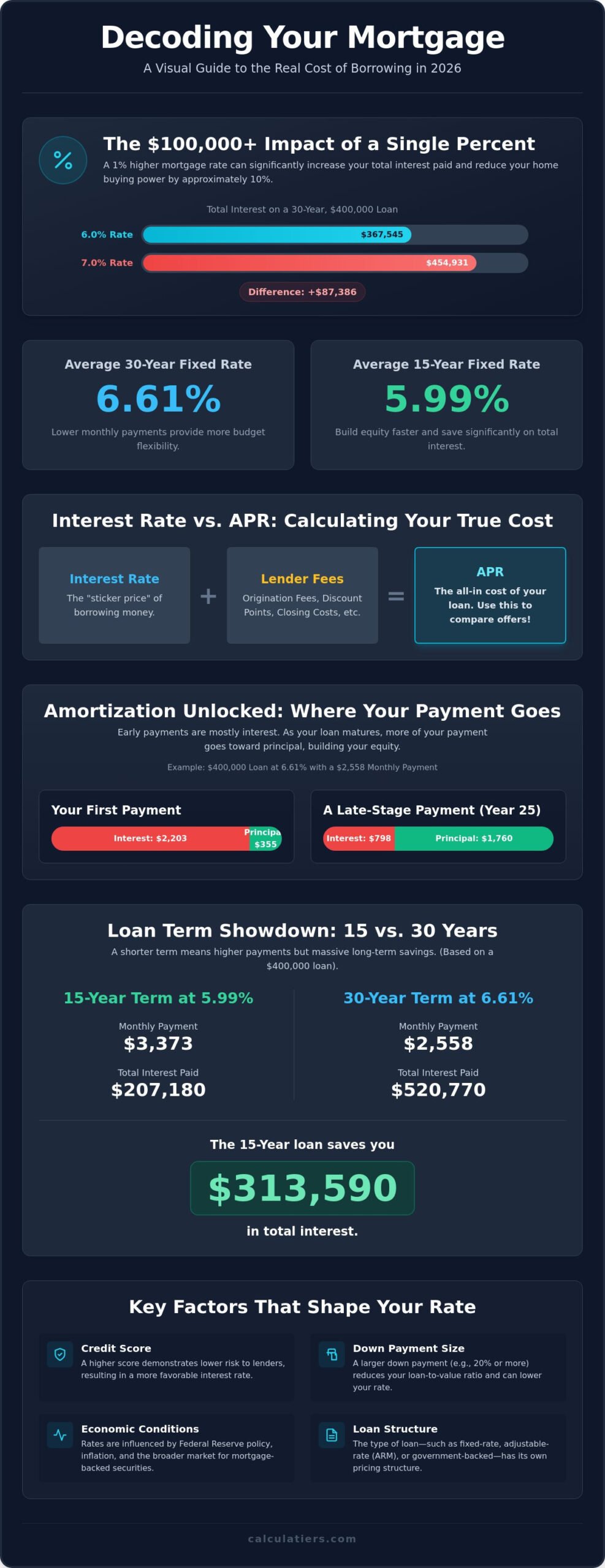
Your specific mortgage and interest rate determines your monthly obligation and the total amount you repay over the life of the loan. As of July 18, 2026, the average 30-year fixed rate is 6.61%, while the 15-year fixed rate averages 5.99%. These percentages aren’t arbitrary. They reflect a complex calculation of lender risk, federal policy, and current market demand. Lenders view the interest rate as their profit margin and a hedge against inflation. For you, it’s the cost of access to housing.
Understanding the difference between the base rate and the total cost of borrowing is essential for accurate budgeting. Over a standard 30-year term, the interest alone can often exceed 50% of the original loan amount. Focus on the total cost rather than just the monthly payment to see the full financial picture.
The Difference Between Interest Rate and APR
The interest rate is the yearly cost of the loan to the borrower. The Annual Percentage Rate (APR) is a broader measure of the cost of credit. It includes the interest rate plus other specific charges such as:
- Mortgage origination fees: Typically ranging from 0.5% to 1% of the loan amount.
- Discount points: Pre-paid interest to lower your long-term rate.
- Closing costs: These usually range from 2% to 5% of the property’s purchase price.
Because it bundles these extra expenses, the APR is almost always higher than the base interest rate. Use the APR as your primary tool for comparing different loan offers to see the true financial impact of the debt.
Why Mortgage Rates Fluctuate in 2026
Rates change daily based on several economic triggers. The Federal Reserve sets the benchmark for short-term borrowing, creating the environment for long-term mortgage pricing. Even though the Fed cut its benchmark rate multiple times in late 2024 and 2025, mortgage rates haven’t fallen at the same pace in 2026. This disconnect happens because lenders must also account for inflation and the secondary market demand for mortgage-backed securities. If investors expect inflation to persist, they demand higher yields, which forces lenders to keep rates elevated. Regional divergence also plays a role; affordable Midwestern markets currently see different pricing pressure than cooling coastal markets.
The Mathematics of Mortgage Interest Calculation
Amortization is the mathematical process of retiring a debt through a schedule of fixed installments. Unlike a simple loan where you might pay the full balance at the end, a mortgage requires monthly payments that cover both the principal and the interest. The lender structures these payments so that the loan is fully paid off by the end of the term. This structure is essential to understand because your mortgage and interest rate don’t just determine your monthly payment; they dictate how quickly you build equity in your home.
Interest is calculated on the remaining principal balance each month. When you make your first payment, your loan balance is at its highest point. Consequently, the interest portion of that payment is also at its peak. As you chip away at the principal over the years, the base amount used to calculate interest shrinks. This creates a shift in your payment’s composition. Early in the loan, your money primarily pays the lender’s fee. Late in the loan, the majority of your payment goes toward owning the home outright. Understanding these types of mortgage loans and their schedules helps you decide if a shorter term or extra principal payments are right for your budget.
Simple Interest vs. Amortized Interest
Simple interest is a straightforward calculation based on the original principal. If you borrowed $100 at 5% simple interest, you would owe $5 in interest regardless of when you paid it back. Mortgages don’t work this way. They use amortized interest to protect the lender from the declining value of money over time. For example, on a $400,000 balance with a 6.61% interest rate, your interest for the first month is approximately $2,203. If your total payment is $2,558, only $355 goes toward your principal. This front-loaded interest ensures the lender receives their profit early in the life of the loan.
How Monthly Compounding Affects Your Balance
Mortgage interest is typically calculated monthly rather than annually. Lenders take your annual mortgage and interest rate and divide it by 12 to find the monthly periodic rate. They then apply this rate to your current outstanding balance. If you have a 6.0% annual rate, the lender applies 0.5% to your balance every month. This frequent calculation is why even small changes in the interest rate have such a massive impact over 30 years. You can see this math in action by using the Calculatiers mortgage calculator, which generates a full amortization table to show exactly where every dollar of your payment goes.
Analyzing the Real Cost: How 1% Changes Your Buying Power
Buying power is the ceiling of your home search. It represents the maximum property value you can afford based on a fixed monthly payment limit. In the 2026 market, your mortgage and interest rate dictate this ceiling more than the property’s listing price. If you qualify for a $3,000 monthly payment, a higher interest rate forces you to look at cheaper homes to stay within that budget. Research on the Impact of Changing Mortgage Interest Rates shows that even minor fluctuations significantly alter affordability for the average buyer. For every 1% increase in the interest rate, your buying power drops by roughly 10%. This means a buyer who could afford a $500,000 home at a 5.6% rate might only afford a $450,000 home if the rate climbs to 6.6%.
The total interest paid over a 30-year term often exceeds the original loan amount. This reality is a product of how amortization spreads costs over decades. When rates are elevated, you aren’t just paying for the house; you’re paying for the house twice. Use a loan repayment calculator to visualize how these interest costs accumulate and to identify the exact point where your monthly budget meets market reality.
The Total Interest Cost Over 30 Years
Small shifts create massive long-term consequences. Consider a $400,000 loan. At a 5.61% rate, you pay approximately $428,000 in total interest over 30 years. If the rate increases to 6.61%, which is the July 2026 average, that total interest jumps to roughly $515,000. You pay $87,000 more for the exact same house. This six-figure gap highlights why securing a competitive rate is often more important than negotiating the seller’s asking price. Making extra principal payments early in the term can mitigate this cost by reducing the balance that interest is calculated against.
Why Small Rate Drops Matter More Than Price Drops
Buyers often obsess over the purchase price while ignoring the financing terms. However, the math favors the rate. A 0.5% reduction in your mortgage and interest rate on a $400,000 home saves you roughly $130 per month. To get that same monthly saving through a price reduction, the seller would need to drop the price by nearly $22,000. Financing terms are the most powerful lever in your housing budget. In 2026, buying power is the measure of how much house your monthly budget can support after accounting for current interest costs. Focus your energy on improving your credit score or increasing your down payment to secure a lower rate rather than just hunting for price cuts.
Comparing Mortgage Terms and Rate Structures
The 30-year fixed-rate mortgage is the standard choice for most homeowners. It provides a predictable monthly payment for three decades, protecting you from future market shifts. While this stability is valuable, it results in a higher total interest cost over the life of the loan. Because the principal is paid back slowly, the lender charges a higher mortgage and interest rate to account for the long-term risk and inflation. This term is ideal if you prioritize monthly cash flow and plan to stay in your home for a long period.
Selecting the right structure requires a clear look at your 2026 financial goals. You must decide whether you want the lowest possible monthly payment or the lowest total cost of ownership. These two goals are often at odds, and the math behind each term will dictate your long-term wealth accumulation.
15-Year vs. 30-Year Fixed Rates
A 15-year term significantly reduces the time you spend paying interest. As of July 18, 2026, the 15-year fixed rate averages 5.99%, while the 30-year fixed is 6.61%. This 0.62% difference, combined with a faster principal reduction, can save you six figures in interest. The trade-off is a much higher monthly payment. Think of this as a forced savings plan. You build equity twice as fast and own your home sooner, but you must have the consistent cash flow to support the higher obligation. Choose the 30-year term if you need budget flexibility, but opt for the 15-year term if your primary goal is debt elimination.
Adjustable-Rate Mortgages (ARMs) vs. Fixed Rates
ARMs offer an alternative when you don’t plan to hold a loan for its full duration. Common structures in 2026 include the 5/1 and 7/1 ARM, which provide a fixed rate for the first five or seven years. After this period, the rate adjusts annually based on market indices. Currently, the 7-year ARM rate is approximately 6.625%. While this is slightly higher than some fixed options today, ARMs often feature “caps” that limit how much the rate can rise during each adjustment period. This structure benefits buyers who plan to sell the property or refinance before the initial fixed period expires. However, in a volatile 2026 economy, the risk of a significant rate reset is a critical factor to consider. You can use a mortgage calculator to model how different rate structures and terms impact your specific amortization schedule.
Strategies to Secure a Lower Mortgage Interest Rate
Securing a competitive mortgage and interest rate requires preparation before you contact a lender. Your financial profile acts as a risk assessment for the bank, directly influencing the pricing they offer. Lenders use your financial history to price their risk, so a lower risk profile results in more favorable terms. Focus on three primary levers to reduce your costs: your credit score, your down payment size, and the strategic use of discount points.
Timing is also a critical factor in the 2026 market. Once you have an accepted offer, discuss a “rate lock” with your lender. This agreement protects you from market volatility while your loan is processed. With the 30-year fixed rate averaging 6.61% as of July 18, 2026, a sudden shift in Federal Reserve policy could increase your monthly obligation before you close. A typical lock lasts 30 to 60 days, ensuring your initial quote remains valid even if market conditions worsen.
Improving Your Credit Score for Better Rates
Aim for a credit score of 740 or higher to qualify for the most aggressive pricing. Borrowers in this tier typically receive the lowest advertised rates. If your score sits between 620 and 680, you may be limited to specific products like FHA loans, which averaged 6.32% in mid-2026. Check your credit reports for errors at least three months before applying. Correcting a single mistake can boost your score enough to move you into a better pricing tier. Additionally, keep your debt-to-income (DTI) ratio below 36%. A lower DTI suggests you can manage the debt reliably, which often leads to a lower mortgage and interest rate offer.
Evaluating Discount Points and Lender Fees
Discount points allow you to “buy down” your interest rate by paying more upfront. One point equals 1% of your loan amount and generally reduces your rate by 0.25%. This is a long-term play. To determine if points are worth the cost, calculate your break-even point. Divide the cost of the points by the monthly savings they provide. If the points cost $4,000 and save you $80 per month, you must keep the loan for at least 50 months to see a profit. Use the Calculatiers mortgage calc to model these upfront costs against your long-term interest savings. This transparency helps you decide if your cash is better spent on a larger down payment or on lowering the permanent rate of the loan.
Master Your Home Financing Strategy
Managing your housing budget in 2026 requires more than just tracking daily market trends. You now understand that a 1% shift in your mortgage and interest rate can alter your buying power by roughly 10% and cost you tens of thousands in extra interest. By comparing the long-term savings of a 15-year term against the flexibility of a 30-year structure, you can make a choice that fits your specific cash flow needs. Your credit score and down payment size remain the most effective tools for reducing the lender’s risk and your own long-term costs.
Success in the housing market starts with precise data. Before you commit to a lender or a specific property, ensure you have a complete picture of your monthly and total repayment obligations. Run the numbers with our free Mortgage Calculator to get instant, browser-based results. Our tool uses bank-standard formulas and requires no sign-up; it gives you an unbiased starting point for your home-buying journey. You have the logic and the tools needed to navigate the 2026 market with confidence.
Frequently Asked Questions
How do mortgage interest rates affect my monthly payment?
Higher rates increase the interest portion of your monthly installment, which raises your total payment. For a $400,000 loan, a 1% rate hike adds approximately $260 to your monthly bill. This calculation directly impacts your debt-to-income ratio and determines the maximum home price you can afford. Lower rates allow more of your payment to go toward the principal balance each month.
What is a good mortgage interest rate in 2026?
A competitive rate is typically anything below the national average, which is 6.61% for a 30-year fixed loan as of July 18, 2026. If you qualify for a 15-year fixed rate near the 5.99% average, you’ve secured a strong offer. Aim for quotes in the bottom quartile of current lender pricing to ensure you’re receiving a market-leading deal for your credit profile.
Can I negotiate my mortgage interest rate with a lender?
Yes, you can negotiate by presenting competing loan estimates from different financial institutions. Lenders often lower their initial rate or reduce origination fees to win your business. Use a formal “Loan Estimate” from one bank as leverage when speaking with another. You can also negotiate the cost of discount points to buy down the permanent rate of the loan.
How often do mortgage interest rates change?
Mortgage rates fluctuate daily and can even shift multiple times within a single business day. These movements follow the bond market, specifically the yield on the 10-year Treasury note. Economic reports, inflation data, and Federal Reserve commentary are the primary triggers for these changes. Lock your rate as soon as you’re satisfied with a quote to prevent increases during the underwriting process.
Should I choose a fixed-rate or adjustable-rate mortgage?
Select a fixed-rate mortgage if you prioritize payment stability and plan to stay in the home long-term. It protects you from 2026 market volatility. An adjustable-rate mortgage (ARM) might be suitable if you plan to sell or refinance within five to seven years. However, with the 7-year ARM averaging 6.625% in July 2026, the initial savings over a fixed-rate loan may be minimal.
What is the difference between the interest rate and the APR?
The interest rate is the cost of borrowing the principal, while the APR represents the total annual cost of the loan. The APR includes the interest rate plus lender fees, closing costs, and discount points. Always use the APR when comparing different loan products. It provides a more accurate picture of the total credit cost and prevents hidden fees from skewing your comparison.
How much can a higher credit score save me on my mortgage?
A high credit score can lower your mortgage and interest rate by 0.5% to 1.5% compared to lower scoring tiers. On a $400,000 loan, moving from a fair score to a score of 740 or higher can save you over $100,000 in interest over 30 years. Lenders reward higher scores with lower risk premiums, which results in significantly lower monthly and lifetime costs.
What happens to my interest rate if I refinance later?
Refinancing replaces your current debt with a new loan at the prevailing market rate. If rates drop below your original 2026 benchmark, a refinance can lower your monthly obligation. You’ll need to pay closing costs again, which typically range from 2% to 5% of the loan amount. Ensure the monthly savings outweigh these upfront expenses by calculating your break-even point before proceeding.